Dorothy C.
84
An interactive rom-com.
v0.6 beta
Ah, another Sunday evening. The city's doing that thing where the light turns everything golden and forgiving, and somewhere out there, a mortal is about to make a series of questionable romantic decisions without your help.
That's where you come in.
You're Cupid—divine matchmaker, cosmic meddler, the reason two strangers will lock eyes across a crowded room and mistake adrenaline for destiny. I'm your advisor. Think of me as the voice in your ear who's read too much Nora Ephron and not enough self-help. Together, we're going to take one lonely soul, find them a match, and shepherd them through an entire first date using nothing but astrological strategy, narrative instinct, and a healthy tolerance for secondhand embarrassment.
The rules are simple: I'll show you a mortal. You'll pick their match from three candidates. Then we'll guide them through four scenes—meet-cute to final moment—where your choices shape everything. Every decision you make reveals something about your romantic instincts too. By the end, we'll know exactly what kind of Cupid you are.
The Arthur Avenue Retail Market on a Sunday morning is one of the last honest places in New York. No reclaimed wood, no chalkboard menus written in someone's idea of charming handwriting—just fluorescent lights, tile floors, and Italian men in aprons who've been selling sopressata since before you were born. Dorothy comes here every week for the bread. Not because she can't get bread in Woodlawn, but because the walk gives her a reason to put on a good coat.
Clarence is not a regular. He's here because his daughter told him to "get out of the house and stop rewatching Columbo," and because a friend from his lodge mentioned they sell real pipe tobacco near the back. He's standing at the counter of a small café stall, studying the pastry case with the focused stillness of a man who once watched signals in the dark for a living (♏️ ☀️).
Dorothy is two people behind him in line. She's already noticed him—the pressed collar, the clean shoes, the way he's taking his time without apologizing for it. She approves. In Dorothy's world, a man who doesn't rush is a man who knows what he's doing.
DOROTHY
(to no one in particular, but loud enough)
"If you're going to stare at the cannoli that long, you might as well marry it."
CLARENCE
(turns, half-smile, not startled—Scorpios don't startle)
"I was deciding between the cannoli and the sfogliatella. That's not a decision you rush."
DOROTHY
"Sfogliatella. Always. The cannoli here are good but they fill them ahead of time. Cream gets soggy."
CLARENCE
"You come here often?"
DOROTHY
"Every Sunday for eleven years. You?"
CLARENCE
"First time. My daughter thinks I need hobbies."
DOROTHY
(small laugh)
"Mine says the same thing. I told her my hobby is minding my own business, and I'm very good at it."
CLARENCE
(genuine laugh—low, warm, surprised out of him)
"That's a full-time occupation in this city."
DOROTHY
"You're telling me. Dorothy." (extends her hand—no hesitation, ♈️ 🔥)
CLARENCE
(takes it, holds it one beat longer than necessary, ♎️ 💖)
"Clarence. Pleasure."
There's a beat. The line moves. They're standing next to each other now, and neither one is pretending to look at the pastry case anymore.
Smart. The side door. No one had to be brave, no one had to risk rejection, and now they're walking together past hanging salami and wheels of provolone like two people who've been doing this for years.
Dorothy mentioned the bread—Addeo's, end of the hall, no discussion—and Clarence said "I'll walk with you, I don't know where anything is in here," which was only half true but entirely the right thing to say (♎️ 💖). They've been moving slowly through the market for twenty minutes now. Dorothy pointed out which mozzarella vendor to trust. Clarence told her about the time he accidentally took the 5 train to the last stop in the Bronx and found a Dominican bakery that changed his life. She laughed in a way that suggested she doesn't do that for just anyone.
Now they're standing outside on the sidewalk, bags in hand, and the February sun is doing its best impression of warmth. The conversation hasn't stopped, but it's reached that inflection point—the one where you either say "well, it was nice to meet you" or you find a reason not to.
CLARENCE
"That's more walking than I've done in a month. My daughter would be proud."
DOROTHY
"Please. That was nothing. I used to be on my feet ten hours a day."
CLARENCE
"What did you do?"
DOROTHY
"Cafeteria manager. PS 19, forty years. Fed three hundred kids a day and not one of them ever said thank you." (beat) "I loved every minute."
CLARENCE
(quietly)
"I drove the 3 train. Thirty-five years."
DOROTHY
"The 3! That's my line. Took it from 238th every morning for a decade."
CLARENCE
(raises an eyebrow, ♏️ ☀️—filing this away)
"What years?"
DOROTHY
"'82 to '93."
CLARENCE
"I was on the 3 from '78 to '98. Morning shift."
DOROTHY
(stares at him)
"You're telling me you might have driven me to work."
CLARENCE
(that low laugh again)
"Every day. And I never even bought you coffee."
The sidewalk is cold. Dorothy's holding her bread bag against her coat. Clarence has shifted his weight toward her, just slightly—the kind of thing you wouldn't notice unless you were, say, a divine entity monitoring body language from above.
Neither of them is saying goodbye.
Clarence said the line. Of course he did—it landed perfectly, the way a Libra Venus can make even a forty-year-old debt sound like a love letter. "Let me buy you that coffee. Forty years late." Dorothy looked at him for exactly two seconds, which in Dorothy-time is the equivalent of a standing ovation, and said, "You're paying."
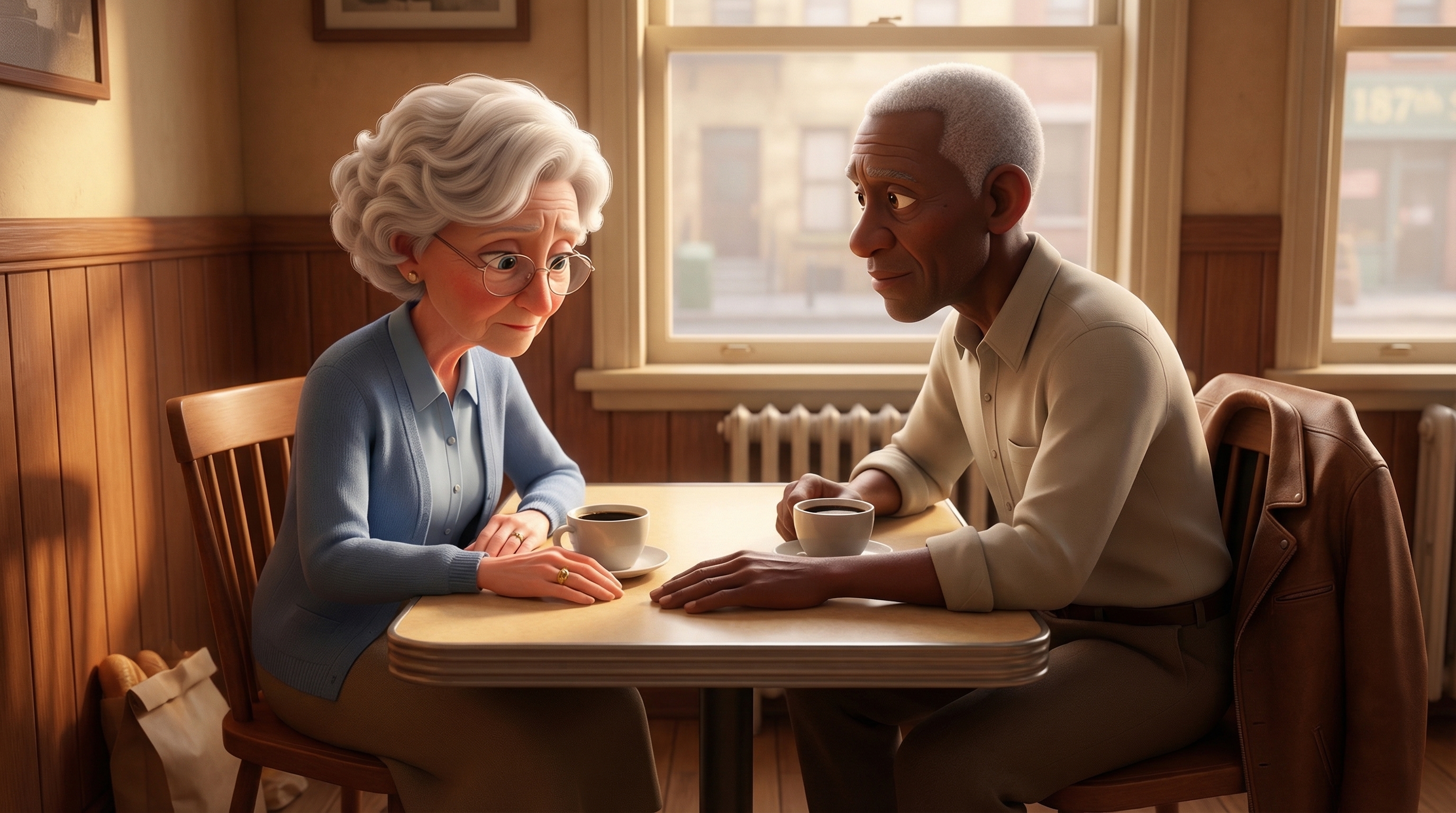
They found a corner table at a café on 187th with wood-paneled walls and a radiator that actually worked. Clarence ordered black coffee. Dorothy ordered black coffee. Neither commented on this, but both noticed. They've been sitting here for forty minutes now, and the bread bags are on the floor, forgotten.
The conversation has done that thing where it stops being about anything and starts being between people. Clarence talked about his wife—passed in 2014, cancer, quick. Said it plainly, the way a Scorpio delivers hard truths: no decoration, no request for sympathy. Dorothy listened without interrupting, which is not her natural state (♈️ 🔥), and that restraint told Clarence more about her than anything she'd said all morning.
DOROTHY
"My husband was Arthur. Heart attack, 2011. Dropped dead at the kitchen table on a Tuesday." (pause) "I had just made pork chops."
CLARENCE
(doesn't flinch, doesn't fill the silence—♏️ ☀️ knows when to hold still)
DOROTHY
"People say the strangest things after. 'He's in a better place.' A better place than my kitchen on pork chop night? I doubt it."
CLARENCE
(quiet laugh, then serious)
"People said that to me too. I stopped answering the phone for a month."
DOROTHY
"A month? I stopped for three."
CLARENCE
"You win."
DOROTHY
(half-smile)
"I always do."
CLARENCE
(leans forward slightly, coffee cup between his hands, ♑️ 🌙—careful, deliberate)
"Do you ever get used to it? The quiet?"
DOROTHY
(long beat—her Taurus Moon weighing whether to let him in)
"No. You just learn where to put it."
The radiator clicks. Someone behind the counter drops a saucer. Outside, a bus hisses to a stop and pulls away. None of this reaches them. They're in that rare pocket of stillness that two people can only build when both of them know what loss sounds like.
Clarence is looking at Dorothy the way he probably once read signal lights—carefully, seriously, with the understanding that what comes next matters.

Clarence moved his hand across the table the way he probably did everything in that train cabin—steady, deliberate, no wasted motion. Not on her hand. Next to it. His fingers resting on the table an inch from hers, palm down, an open question with no pressure behind it (♎️ 🔥).
Dorothy looked at his hand. Then at him. Then back at his hand. Three seconds that lasted about a year and a half. And then she closed the distance—just her pinky finger, hooking over his, the way you might test whether a radiator is actually warm before you commit to leaning against it. Clarence didn't move. Didn't squeeze. Just let it happen. The Capricorn Moon understanding, instinctively, that Dorothy's trust arrives on Dorothy's schedule and not a moment sooner.
They sat like that for a while. The café had mostly emptied—the Sunday brunch crowd replaced by a lone man reading Il Progresso and a teenager on a laptop who hadn't looked up in an hour. The light through the window had shifted from morning white to that pale gold that means the afternoon is coming whether you're ready or not.
DOROTHY
(not moving her hand)
"This coffee is terrible."
CLARENCE
"Worst I've ever had."
DOROTHY
"We've been here an hour."
CLARENCE
"Hour and ten minutes."
DOROTHY
(looks at him sideways)
"You've been counting?"
CLARENCE
(♏️ ☀️, absolutely unapologetic)
"I notice things."
DOROTHY
"Hmm." (This is high praise.)
CLARENCE
(stands slowly, picks up her bread bag before she can reach for it)
"Can I walk you to the bus?"
DOROTHY
"I take the Bx34."
CLARENCE
"I know where the Bx34 stops."
DOROTHY
"Of course you do. Train man."
They're outside now. February doing its worst, but neither of them is hurrying. Clarence is carrying her bread. Dorothy is walking close enough that their coat sleeves touch when the sidewalk narrows. The bus stop is half a block away, and they're both walking slower than they need to.
They arrive. The stop is empty. No bus in sight—which in the Bronx could mean two minutes or twenty. They're standing face to face, and Clarence is still holding her bread.
Dominant Sign
Libra
Sep 23 – Oct 22
Can see both sides of any argument, which is why they can’t pick a restaurant. Charming, indecisive, and genuinely fair.
Cupid is immortal and has no sign. But Cupid does exhibit influences:
Tonight you played it like someone who understands that love at eighty-four isn't about fireworks—it's about architecture. Every move you made was calibrated, graceful, and quietly devastating.
Dominant Sign: Libra — Grace under pressure.
Look at what you did. Scene one: you didn't let Dorothy charge in with that Aries Mars, and you didn't force Clarence to perform his Libra Venus charm on command. You chose the side door—the shared errand, the walk through the market—because you understood that two people who've been self-sufficient for a decade don't want to be asked on a date. They want to find themselves already on one. That's Libra thinking. Not indecision. Integration.
Then the coffee callback—you let Clarence deploy that "forty years late" line because you knew the balance had shifted enough for charm to land as sincerity, not performance. And the gesture in Scene 3? Hand on the table, not on hers? That was your masterpiece, Cupid. You gave Dorothy the space to close the distance herself, which is the only way a Taurus Moon will ever let someone in. You weren't managing two people. You were tuning an instrument.
The final move sealed it. No kiss—too soon. No ambiguity—too risky at eighty-five. Just a clear, honest promise: next Sunday, nine o'clock, same place. You understood that for Dorothy and Clarence, the most romantic thing in the world isn't a grand gesture. It's showing up.
Real Libras know something most people don't: that restraint is its own kind of boldness. Anyone can push. It takes genuine skill to hold back at exactly the right moment and let two people find each other on their own terms. That's what you did tonight on Arthur Avenue—you gave Dorothy and Clarence room to discover that the 3 train wasn't the only thing they'd been sharing all along.
He'll be there at eight-fifteen. She knows it. And next Sunday, when she walks into that market and sees him already standing at the sfogliatella counter with two coffees, that's your work, Cupid. That quiet miracle is yours.
Until next time, divine one.